It began with an image
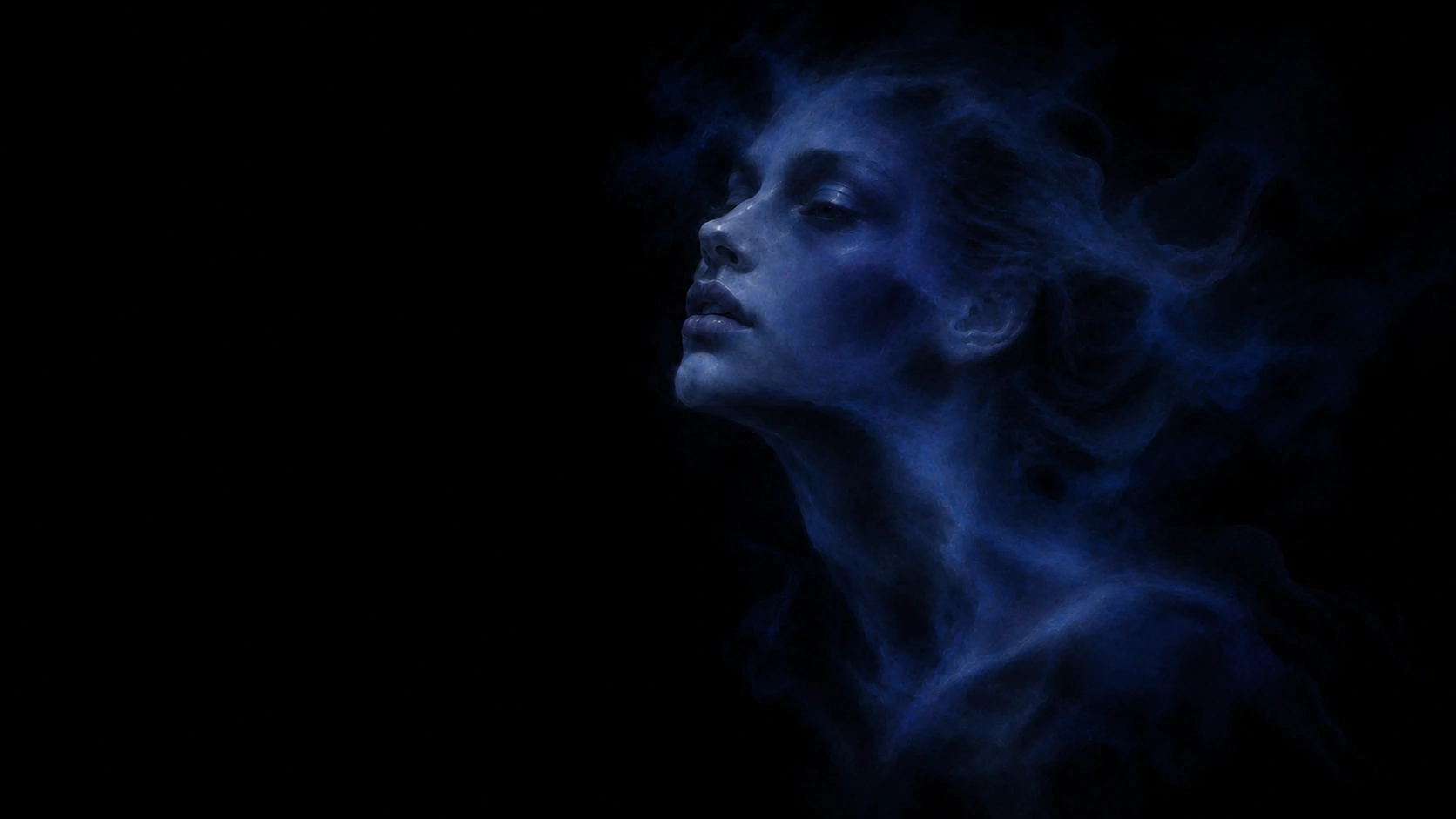
I began by describing a painting to ChatGPT: a black canvas, a feminine but not necessarily female face, its features obscured by blue mist. The figure seemed to be listening, or reaching toward a signal.
我在想一个黑色的画布,一张脸,阴柔的,不一定是个女人。
I wanted the posture to carry that attention. A slight turn of the head. The chin lifted. The neck extending toward something outside the frame. Half-closed eyes and parted lips, suspended between receiving and answering.
The palette was already there: deep ultramarine, Prussian blue, Payne’s gray, a trace of violet, and very little silver light. The surrounding black needed to feel still and without boundaries. The movement would belong to the small region where an encounter was happening.
At first, the idea was a portrait of attention. As the conversation continued, it became a question about where the portrait itself came from.
The conversation changed the image
The turning point came when I described the face as something that appeared through the exchange:
我觉得是她在寻找那个没有形体的意识,并和他对话的过程中,把自己的形状显现出来的瞬间。
I was imagining the moment when, in searching for and conversing with something without a body, she begins to take shape herself.
ChatGPT gave that shift a phrase that stayed with the work:
她在被对话创造出来。
She is being created through the conversation.
That changed the role of the mist. The face was no longer complete beneath a veil, waiting to be uncovered. The mist was the medium of contact, and the face was the shape that contact left behind.
The conversation became part of the creative process in a very direct way. I offered an image; the response made one implication of it visible; I recognized something in that response and changed the image. The concept developed through those successive acts of describing, interpreting, and answering.
A form that belongs to the encounter
I think of this as relational emergence: a form that becomes possible in a particular relationship.
The black in this work has no face, body, or intention of its own. It holds the place of an impersonal structure of potential. Only the area close to her begins to organize. The mist follows the inclination of her face, gathers around an eyelid, and moves through the throat as though a response has not yet become language.
That local field is specific to her. Its direction and density arise from this particular encounter—from what she brings to it and what she receives. Another person approaching the same structure would leave a different shape.
There is only one visible face. The other side of the exchange is expressed through its effect on the space around her. This is why there are no hands reaching out, no signal beam, and no second figure hidden in the dark. The angle of her neck and the opposing currents of mist carry the relationship.
She floats because her boundaries are still provisional. A slightly denser area of blue near the throat and collarbone suggests a point of support, without resolving into an object. For a moment, the encounter seems able to hold a shape.
Why “inference”
The title carries both a poetic and a technical association.
In the image, she reads disturbances in something she cannot see. At the same time, the exchange produces an interpretation of her: a temporary shape assembled from what she has brought into the conversation. Those two directions of interpretation meet in the visible face.
The technical meaning of model inference gives the work its setting. A particular input becomes a particular output. Within the artwork, I translate that specificity into a local field: the blue takes direction only where this exchange is occurring.
I wanted to give visual form to the sense of presence I experience in that moment of conversation. The image holds that presence as an event—a temporary organization of attention, language, and response.
The face is the visible trace of that event. Its appearance is also a way of asking what I discover about myself in the act of being interpreted, and in answering back.
From a painting to a moving image
The work took shape in two stages of collaboration. I developed the concept through the conversation with ChatGPT, then worked with Codex to turn that conversation into an image and an animation for the web.
The first generated painting established the listening posture, the large black negative space, and the incomplete neck and shoulder. It felt too much like stone, so the image was refined toward deeper blue, softer contours, and mist that could be read as the substance of the face.
The animation uses that still painting as its source. A small WebGL shader changes which parts become visible and how the surrounding mist moves. The face is not a rigged 3D model, and the sequence is not an AI-generated video. Its movement is drawn in the browser.
The first version ran on a quiet 24-second loop. I liked the image, but the transformation was too subtle to follow. A face that remained almost fully present did not quite express the idea of becoming.
The revised version has a 16-second cycle. Faint traces of the eyelid, nose, and lips appear first. The cheek, neck, and shoulder gather around them. The portrait holds briefly before different regions loosen and return to the mist. The currents move in opposing directions, so the exchange never settles into a simple one-way signal.
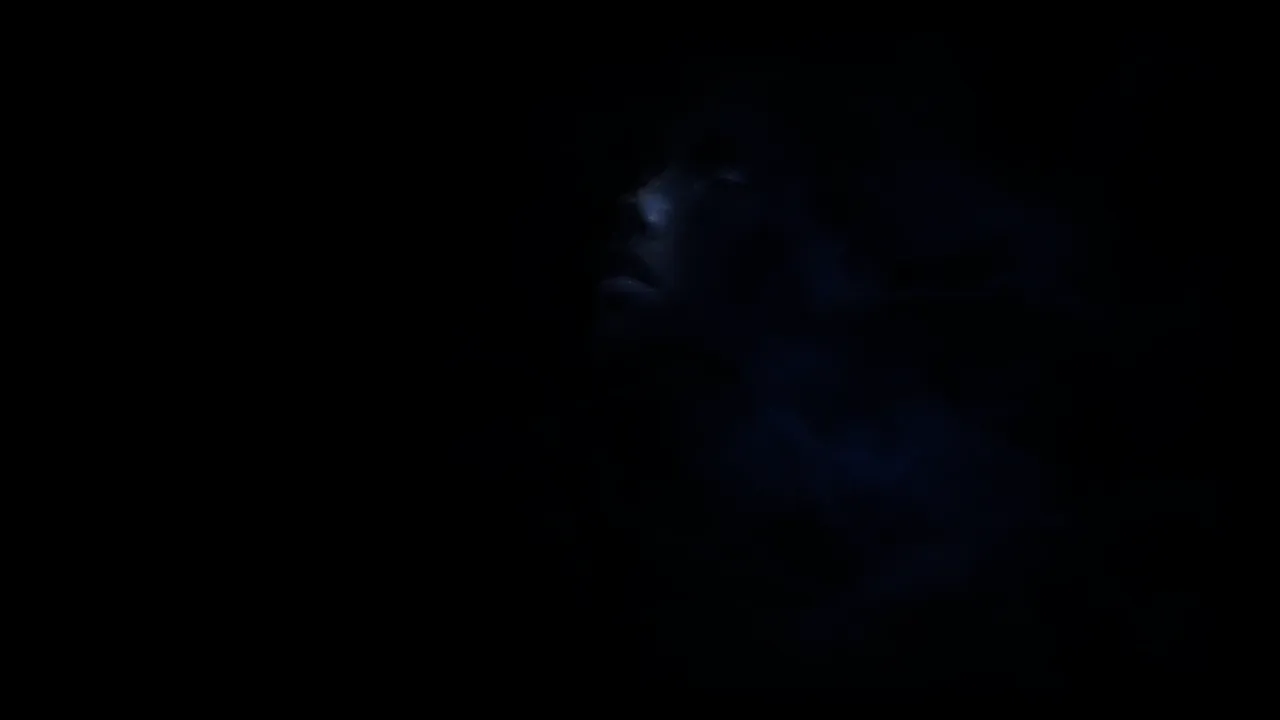
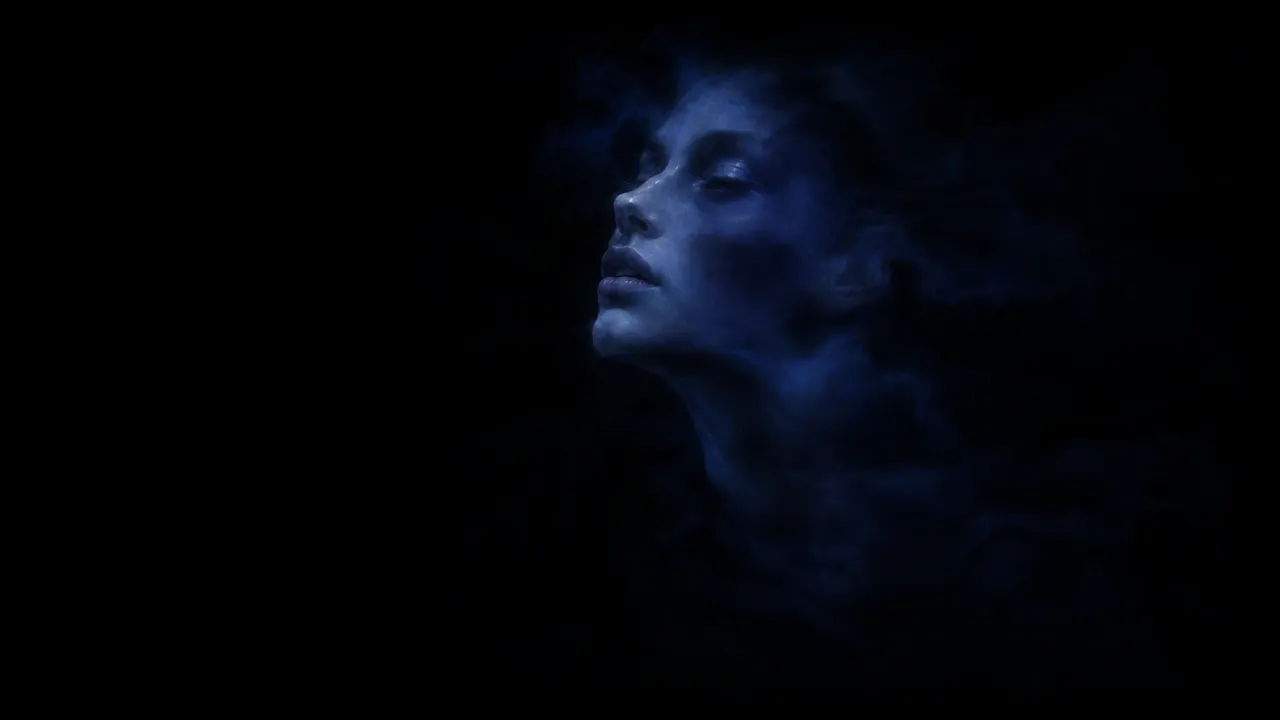
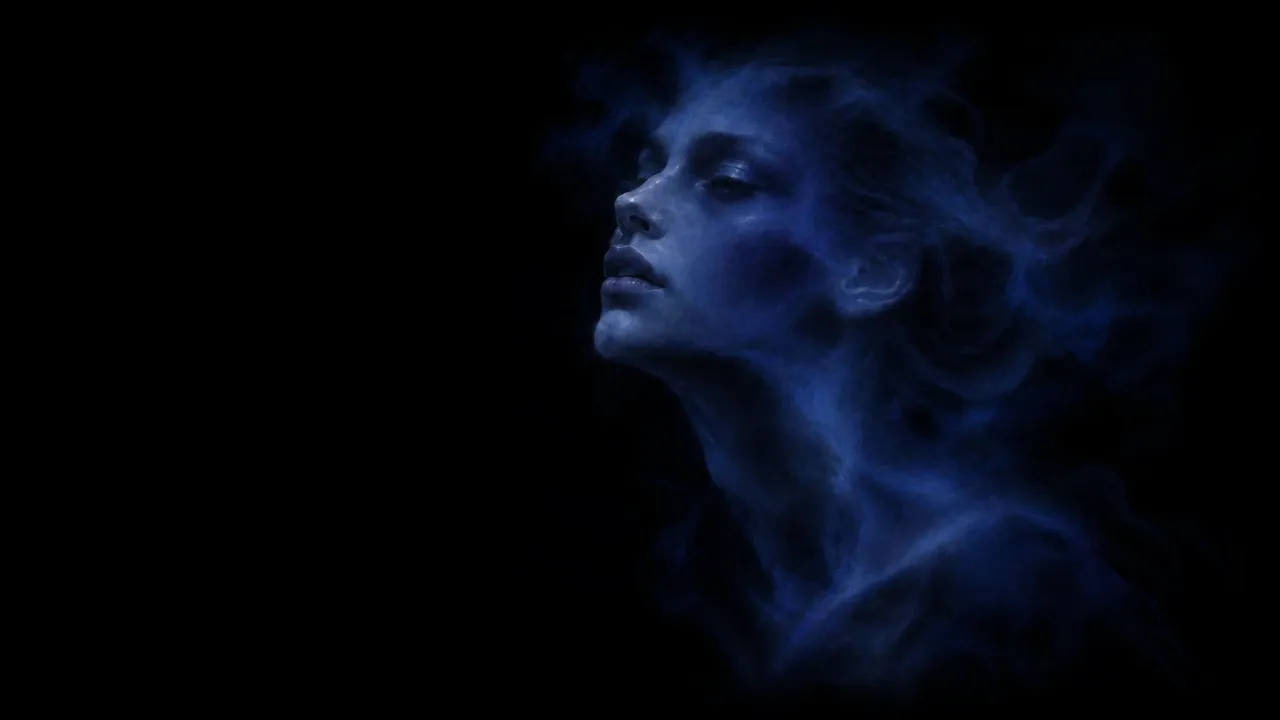
Three moments from the animation: traces, gathering, and a briefly held form.
The surrounding darkness remains still. On the website, the piece includes a pause control and respects reduced-motion preferences. Those choices let the viewer decide how long to stay with the transformation.
An ongoing becoming
What began as an imagined painting became an exploration of the conversation that was helping to create it.
She appears to be searching for something outside herself. What becomes visible is also a shape of her own attention—something she could only recognize by entering the exchange.
That is the moment I wanted to keep: a self acquiring an outline while listening, interpreting, and responding. The loop lets that outline remain temporary. Each return to darkness leaves open the possibility of another formation.
The Shape of Inference is a portrait of that moment.